A creator posts a Short that reaches one million views in 48 hours. She earns $40.
Her friend posts a finance tutorial that reaches 40,000 views over two weeks. He earns $600.
Same platform. Same week. One video got 25 times more views. The other earned 15 times more money.
This is not an edge case. This is how YouTube’s revenue architecture actually works in 2026 and most creators don’t fully understand it until they’ve spent months posting Shorts and wondering why their earnings don’t move.
I’ve spent over a decade studying creator economics, and the Shorts vs long-form question is the one I get asked more than any other. This article gives you the real numbers verified data from across hundreds of channels and the honest strategic answer of YouTube Shorts vs Long Videos Which Earns More ? most guides are too careful to give you.
The Direct Answer — No Hedging
Long-form videos earn more money per view than YouTube Shorts in 2026. By a significant margin. The gap is structural, not temporary, and it is unlikely to close meaningfully in the next 12–18 months.
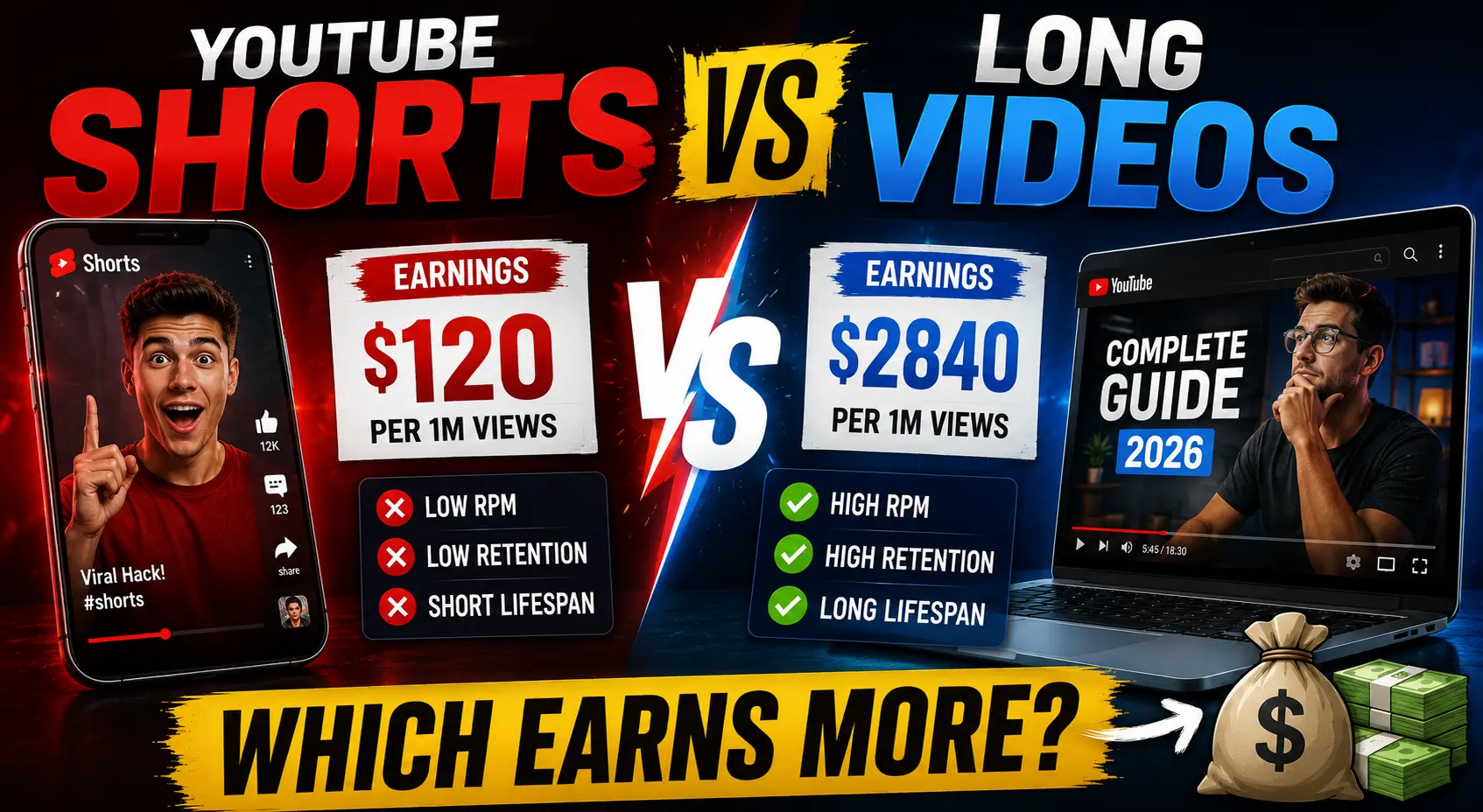
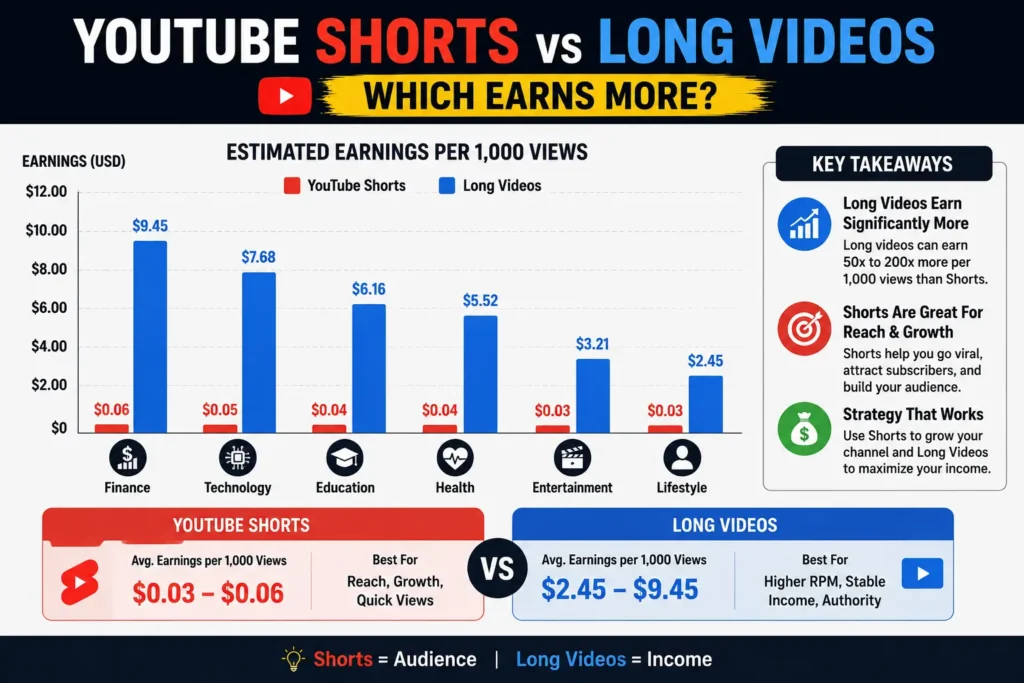
YouTube Shorts generate RPM between $0.03 and $0.08 per 1,000 views in 2026. Long-form videos in the same niches generate RPM between $1 and $10 a gap of roughly 20 to 30 times.
The median Shorts RPM across all niches is $0.05, while the median long-form RPM is $2.50.
Put another way: a long-form video with 100,000 views earns the same as a Short with 10,000,000 views. This 100:1 ratio is not an exaggeration it reflects the structural differences in how each format is monetized.
If you are making content decisions purely based on ad revenue potential, the answer is long-form, every time. That is the honest answer. But revenue per view is only one part of the picture, and the creators who are actually earning the most in 2026 understand the other parts. Let’s go through all of it.
Why Shorts Pay So Little: The Structural Explanation
The RPM gap between Shorts and long-form is not arbitrary. It is the result of four structural differences in how YouTube monetizes each format and understanding them tells you whether those differences are likely to change.
Reason 1: Different ad mechanics
Long-form videos can be monetized in the watch-page environment. Eligible long-form videos may include ads around the video experience, and videos longer than 8 minutes can be set up for mid-roll ad opportunities where available.
Shorts work completely differently. Unlike long-form videos, they don’t have ads plastered right in the middle of your video. Instead, the cash comes from a shared pool.
When you post a long-form video, advertisers bid to place ads specifically on your content before it starts, during it, and after it ends. The more relevant your audience is to what the advertiser sells, the higher they bid. Your video’s topic, your audience’s demographics, their location all of it influences the specific price.
When you post a Short, ads don’t run on your individual video at all. They run between videos in the Shorts feed. That revenue gets pooled, and your share is simply your proportion of total Shorts views across all creators worldwide. Your topic barely matters. Your audience location matters less. You’re sharing a pool with millions of other creators.
Reason 2: Creator share is reversed
On long-form, creators receive 55% of ad revenue. On Shorts, creators receive 45%, and YouTube retains 55%, partly to cover music licensing costs.
This is the exact opposite of the long-form split. Even before accounting for the RPM gap, Shorts creators are starting at a 10-percentage-point structural disadvantage per dollar of pool revenue allocated to them.
Reason 3: Viewer intent is different
People often consume Shorts by scrolling. A viewer watching a long-form video may be solving a problem, comparing options, learning a process, or spending several minutes with one creator’s explanation.
Advertisers pay premium prices to reach viewers who are actively researching something a product, a service, a decision. Long-form viewers signal that intent through their behaviour. Shorts viewers signal browsing and entertainment. That difference in intent directly affects how much advertisers will pay to reach each audience.
Reason 4: Shorter sessions compress ad inventory
A 20-minute tutorial can carry a pre-roll ad, two mid-roll ads, and a post-roll. That’s four ad impressions per view, each targeting a viewer who has demonstrated sustained interest. A 45-second Short generates a fraction of that inventory and none of it is directly attributed to your content’s topic.
The Real RPM Numbers in 2026
YouTube Shorts RPM ranges from $0.01 to $0.07 per 1,000 views. At $0.03 RPM, you need 3.3 million views to earn $100.
Here is what that looks like across formats and niches in a single comparison:
| Format | Niche | RPM Range | Revenue per 1M views |
|---|---|---|---|
| Long-form | Finance & Investing | $10–$25 | $10,000–$25,000 |
| Long-form | Technology | $8–$15 | $8,000–$15,000 |
| Long-form | Health & Wellness | $5–$16 | $5,000–$16,000 |
| Long-form | Gaming | $1.50–$5.50 | $1,500–$5,500 |
| Long-form | Lifestyle/Vlog | $1.50–$5.50 | $1,500–$5,500 |
| Shorts | Finance | $0.05–$0.30 | $50–$300 |
| Shorts | Technology | $0.04–$0.10 | $40–$100 |
| Shorts | Gaming/Entertainment | $0.01–$0.07 | $10–$70 |
| Shorts | General | $0.03–$0.05 | $30–$50 |
Finance Shorts earn 10× more than comedy Shorts but still trail long-form by 50–100×.
The implication is stark: 1 million views in finance on long-form earns $10,000–$25,000. The pooled revenue model, 45% creator share, and music licensing costs all compress Shorts earnings dramatically.
One number that tends to shock creators seeing it for the first time: only 14% of Shorts creators earn $1,000+ per month from ad revenue, and those typically have 50M+ monthly views.
The 100:1 Ratio You Need to See
This is the most important number in this entire article. Read it twice.
It takes 11,000–34,000 Shorts views to match 1,000 long-form views in revenue. Music channels need only around 1,100 (roughly 1:1). Kids and Teens large channels need approximately 2,156. Everyone else is in the 11,000–26,000 range, with Crafting at the far end at 34,000.
Let that sink in. For most creators, in most niches, you need to generate between 11,000 and 34,000 Shorts views to earn what 1,000 long-form views would generate. That is not a 2× or 5× gap it is a scale entirely different. If your long-form videos consistently reach 50,000 views, you would need 550,000 to 1,700,000 Shorts views every month just to match that revenue.
Direct Shorts revenue is negligible for most channels, accounting for less than 2% of total revenue while consuming a meaningful share of total production time.
When someone tells you Shorts are a path to revenue, that 2% figure is the reality check. They are not a path to revenue directly. They can be something else entirely — but we’ll get to that.
Where Shorts Genuinely Win
I want to be precise here, because dismissing Shorts entirely would be wrong. They genuinely win on three specific dimensions just not the ones most new creators assume.
Discovery reach
YouTube’s algorithm pushes Shorts far more aggressively to non-subscribers. A typical Short reaches 5–20× more unique viewers than a typical long-form video on the same channel. Shorts appear in the Shorts shelf, on the homepage, and in external app recommendations.
For a new channel particularly having less than 50 subscribers where building an audience from scratch is the primary challenge this reach asymmetry is genuinely valuable. Shorts can introduce your channel to audiences that would never find you through search alone.
Subscriber acquisition
Shorts convert viewers to subscribers at higher rates than long-form content because the commitment to watch is minimal.
A viewer who clicks on a 15-minute video is making a real time commitment. Many will assess the first 30 seconds and leave. A viewer who sees a 45 second Short to the end has already watched the whole thing — the conversion happens at a higher completion rate, and subscribe decisions often follow completion.
Speed of reach for new channels
YouTube Shorts now generates over 200 billion views per day. Shorts leads all short-form platforms in engagement with a 5.91% rate.
That is an enormous discovery platform. Used as a funnel rather than a revenue source, it is genuinely one of the fastest ways to grow a new channel’s subscriber base in the current YouTube landscape.
The Music Licensing Trap Most Creators Walk Into
This is the detail I rarely see in Shorts revenue articles, and it can cut your earnings by half.
Before creators see anything, music licensing costs are deducted. Zero tracks means keep all. One licensed track means losing approximately 33%. Two or more tracks means losing approximately 50%. This is why using original audio dramatically increases earnings.
The specific mechanics: the revenue pool is divided up among millions of views and adjusted for music licensing. Creators often notice that they earn a higher RPM on short videos that use original or non-copyrighted sounds compared to those that are full of music, even if the latter get more views.
This catches a large number of creators because the viral potential of a Short often seems to increase when popular music is used. The Short gets more views, the creator feels like it performed better, and they never realise that the licensed music track consumed a third of their already-small revenue share before they received anything.
The rule is simple: if you want to maximise Shorts revenue, use original audio, voiceover, or royalty-free music. The Short that earns $40 with trending licensed music might earn $60 with original audio on identical views. When your RPM starts at $0.03–$0.05, that 33–50% difference is not trivial.
Earnings Comparison by Niche
Not all niches experience the Shorts RPM gap equally. Here is where it is most severe and where it compresses slightly.
Most severe RPM gap (long-form wins by 50–100×):
YouTube Shorts RPM for the finance niche averages $0.05–$0.30 per thousand views, compared to $10–$25 for long-form content. Finance Shorts earn 10× more than comedy Shorts but still trail long-form by 50–100×.
Education has the highest RPM in the dataset at $14.97–$18.23 and zero Shorts channels in the sample. The opportunity cost of shifting Education views to Shorts is the largest of any niche.
If you run a finance, education, legal, or B2B software channel, the case for prioritising Shorts revenue over long-form revenue is essentially non-existent. The gap is too wide. You would need tens of millions of Shorts views to match what a well-optimised long-form channel earns on a fraction of the views.
Narrowest RPM gap:
Music channels need only around 1,100 Shorts views to match 1,000 long-form views in revenue. Kids and Teens large channels need approximately 2,156 related to a COPPA effect where Shorts have a 45.7% monetised playback rate versus 12.1% for long-form.
Gaming, meanwhile, is the stable exception where long-form and Shorts both pay comparably poorly. Across 10 channels in the within-channel sample, RPM barely shifts between Shorts months and non-Shorts months $3.42 versus $3.29. For gaming creators, the RPM argument either way carries less weight the income disparity between gaming Shorts and gaming long-form is far smaller than in premium niches.
The Case Where Shorts Actually Make Sense Financially
Given everything above, here is when the Shorts-first strategy actually makes financial sense:
Case 1: You are building a new channel from scratch
Shorts are better used as a discovery tool. If you have zero subscribers and zero search authority, Shorts compress the timeline for acquiring both. The Shorts revenue during this growth phase is negligible but the subscribers you accumulate will watch your long-form content and generate real RPM. The economics only make sense if you treat Shorts revenue as irrelevant during the growth phase.
Case 2: Affiliate and sponsorship income compensates for ad revenue weakness
76% of top-earning Shorts creators make more from brand deals and sponsorships than from ad revenue. Only 8% of Shorts creators rely on ads as their primary income source. Shorts with product mentions in the first 10 seconds see 22% higher affiliate sales.
If your content category has strong affiliate products (tech, finance, beauty, health), Shorts can generate meaningful affiliate revenue even at the RPM rates described above. The Shorts viewer who sees a product recommendation and clicks through to buy contributes affiliate income that is completely separate from the ad revenue pool.
Case 3: You can produce Shorts in significantly less time than long-form
AI-generated Shorts can actually beat long-form on a per-hour basis despite the RPM gap. A creator who spends one hour using AI tools to make ten Shorts that earn $70 total earns $70 per hour.
The production method dramatically affects which format is more time-efficient. A creator who can produce ten Shorts in the time it takes to produce one long-form video changes the per-hour earnings calculation entirely, even if per-view earnings remain far lower.
What 274 Real Channels Tell Us
In early 2026, AIR Media Tech pulled verified data directly from the YouTube Analytics API across 274 channels that mix Shorts and long-form content. This is the most rigorous multi-channel dataset available on this topic, and several findings from it should directly influence your content strategy.
The within-channel comparison shows the same channels earning $4.58 RPM in months without Shorts and $1.84 in months with Shorts — a 60% drop. The dose-response goes further: $4.99 at 0 Shorts per month falls to $1.15 at 21+ Shorts per month — a 77% decline.
This finding deserves to sit for a moment. Adding Shorts to a channel that previously had none was correlated with a 60–77% drop in long-form RPM on the same channel. The causality is not proven it could be that the Shorts bring in a different audience that converts less well for advertisers, or that the algorithm adjusts how the channel is categorised, or simply that the view mix shifts toward lower-value Shorts views that dilute the overall channel RPM metric.
Gaming is the stable exception. Across 10 channels in the within-channel sample, RPM barely shifts between Shorts months and non-Shorts months.
The Entertainment medium cross sectional gap is stark: irregular Shorts channels earn $559 per month versus $2,979 for pure long-form channels in the same niche. Shorts are generating 26% of their traffic and 1.5% of their income.
That last statistic is the clearest single-line summary of the Shorts economics problem. 26 % of traffic. 1.5% percent of income. And in some cases, that traffic appears to be diluting the RPM on the long-form income too.
None of this means Shorts are always wrong. The Arts and Crafts channel case achieved a 64% revenue increase in 30 days from a Shorts strategy — none of that revenue came from Shorts RPM. It came from the long-form views that Shorts viewers went on to watch.
That is the clean distinction: Shorts as a direct revenue source fails the math. Shorts as a funnel that fills a high-RPM long-form channel with new viewers can work well.
The Hybrid Strategy That Beats Both
Based on all of the data above, here is the approach that consistently outperforms both pure Shorts and pure long-form channels in 2026:
Post Shorts as a discovery layer, not a revenue layer
Produce 3–5 Shorts per week. Each Short should connect directly to a long-form video either clipping the most compelling 30–60 seconds from an existing long-form video, or creating a standalone Short that teases a longer treatment.
End every Short with a reference to a related long-form video. Use pinned comments linking to the full video. Track how many long-form views originate from Shorts viewers.
The Shorts RPM is not your metric of success here. The metric is Shorts-to-long-form conversion: how many viewers who saw your Short went on to watch a full video. That conversion generates the real revenue.
Make long-form videos longer than 8 minutes
Focus on high-RPM topics within your niche and make long-form videos 10+ minutes with mid-roll ads enabled.
The mid-roll ad unlock at 8 minutes is one of the most impactful technical decisions a creator makes. A 7-minute video earns from pre-roll and post-roll only. A 10-minute video earns from two additional mid-roll placements. In high CPM niches, that difference compounds significantly across a video catalogue.
Never use licensed music in Shorts
Using one licensed track reduces earnings by approximately 33%. Two or more tracks reduces earnings by approximately 50%. Use original audio or royalty-free tracks on every Short. At $0.03–$0.05 base RPM, protecting 100% of your allocated share is more valuable than any viral boost trending audio might provide.
Track revenue by format separately in YouTube Studio
Review your Shorts subscriber conversion rate monthly — this is the metric that tells you whether your Shorts investment is paying off through long-form audience growth.
YouTube Studio shows long-form and Shorts revenue separately in the Revenue dashboard. Check both each month. If Shorts represent more than 20% of your ad revenue, you may be under-investing in long-form content. If long-form is carrying 90%+ of revenue on 60% of your views, your Shorts strategy is working correctly.
How to Check What Your Channel Is Actually Earning
Before you make any format decision, check where your channel actually sits right now and what channels similar to yours are earning.
Use Toolbil’s free YouTube Monetization Checker to check any public YouTube channel’s estimated monthly earnings, CPM by country, subscriber count, and monetization status instantly, no login required. Enter a competitor’s channel or your own to get an external estimate of what you’re working toward.
If your channel is at a point where brand sponsorships make sense on top of AdSense, use Toolbil’s free YouTube Sponsorship Calculator to see what your channel should be charging brands based on your views, niche, and audience location. Sponsorship revenue is particularly important for Shorts creators, since 76% of top-earning Shorts creators make more from brand deals than from ad revenue.
Frequently Asked Questions
Do YouTube Shorts or long videos earn more money in 2026?
Long-form videos earn significantly more per view in 2026. The median Shorts RPM is $0.05 per 1,000 views, while the median long-form RPM is $2.50. That is a 50× gap at the median, and the gap widens further in high value niches like finance, education, and B2B software.
How much do YouTube Shorts pay per 1,000 views in 2026?
YouTube Shorts pay between $0.01 and $0.07 per 1,000 views (RPM). The midpoint is approximately $0.03–$0.05. This means 1 million Shorts views generates roughly $30–$70 in ad revenue before music licensing deductions if licensed tracks are used.
How many Shorts views equal 1,000 long-form views in revenue?
It takes 11,000–34,000 Shorts views to match 1,000 long-form views in revenue for most niches. Music channels are the exception at approximately 1,100:1. For finance, education, or B2B creators, the ratio is closer to 34,000:1.
Why do YouTube Shorts pay less than long-form videos?
Four structural reasons: The pooled revenue model, 45% creator share, and music licensing costs all compress Shorts earnings dramatically. Specifically: ads run between Shorts in the feed rather than on individual videos, creators keep 45% versus 55% for long-form, music licensing fees are deducted before the creator split, and shorter sessions give advertisers less targeting data per view.
Can I make a full-time income from YouTube Shorts alone?
Very unlikely from ad revenue alone. Only 14% of Shorts creators earn $1,000+ per month from ad revenue, and those typically have 50M+ monthly views. A sustainable income from Shorts requires stacking brand deals, affiliate commissions, and channel memberships on top of ad revenue with ad revenue being the smallest piece.
Should I stop posting Shorts and focus only on long-form?
Not necessarily. The Arts and Crafts channel achieved a 64% revenue increase in 30 days from a Shorts strategy none of that revenue came from Shorts RPM. It came from the long-form views that Shorts viewers went on to watch. Shorts as a discovery funnel that feeds a high-RPM long-form channel is a legitimate and proven strategy. Shorts as a primary revenue source is not.
Do Shorts help or hurt long-form RPM?
The within-channel comparison shows channels earning $4.58 RPM in months without Shorts and $1.84 in months with Shorts a 60% drop when Shorts are added at high frequency. The causality is unproven, but the pattern across 274 channels is consistent enough to warrant careful tracking of your own long-form RPM when you add Shorts to an established channel.
What is the best strategy for YouTube monetization in 2026?
The creators who try to earn primarily from Shorts ad revenue are fighting the math. Creators who use Shorts strategically to grow their long-form audience get the best of both worlds. Post 3–5 Shorts per week as a discovery layer. Post 1–2 long form videos per week as your revenue engine. Track the conversion from Shorts viewers to long-form watch time monthly, and treat Shorts RPM as a minor bonus rather than a meaningful income stream.
The Bottom Line
After twelve years of watching creator economics evolve, my read on 2026 is this: Shorts are the most powerful discovery tool YouTube has ever given small creators, and the worst primary revenue source they’ve ever launched.
The honest summary: Shorts ad RPM is real but small. At $0.03 RPM, you need 3.3 million views to earn $100. But if you treat Shorts as your growth engine and discovery layer, the total revenue picture changes completely.
The creators winning in 2026 are not choosing between Shorts and long-form. They are using Shorts to fill a long-form funnel building subscribers at scale through short-form reach and converting them to revenue through long-form watch time.
Long-form earns. Shorts grow. Both together is where the real income lives.
Before you decide which direction to weight your content strategy, check what similar channels are actually earning using Toolbil’s free YouTube Monetization Checker. Real data on what your competitors make is more useful than any general benchmark.

Jordan Blake
Hey ,I'm Jordan Blake a Dallas based YouTuber and digital marketing strategist with 8 years of experience growing YouTube channels across finance, tech, and SaaS niches. I negotiated brand deals with companies including NordVPN, Squarespace, and Shopify, and currently manages monetization strategy for a portfolio of mid tier US YouTube channels.