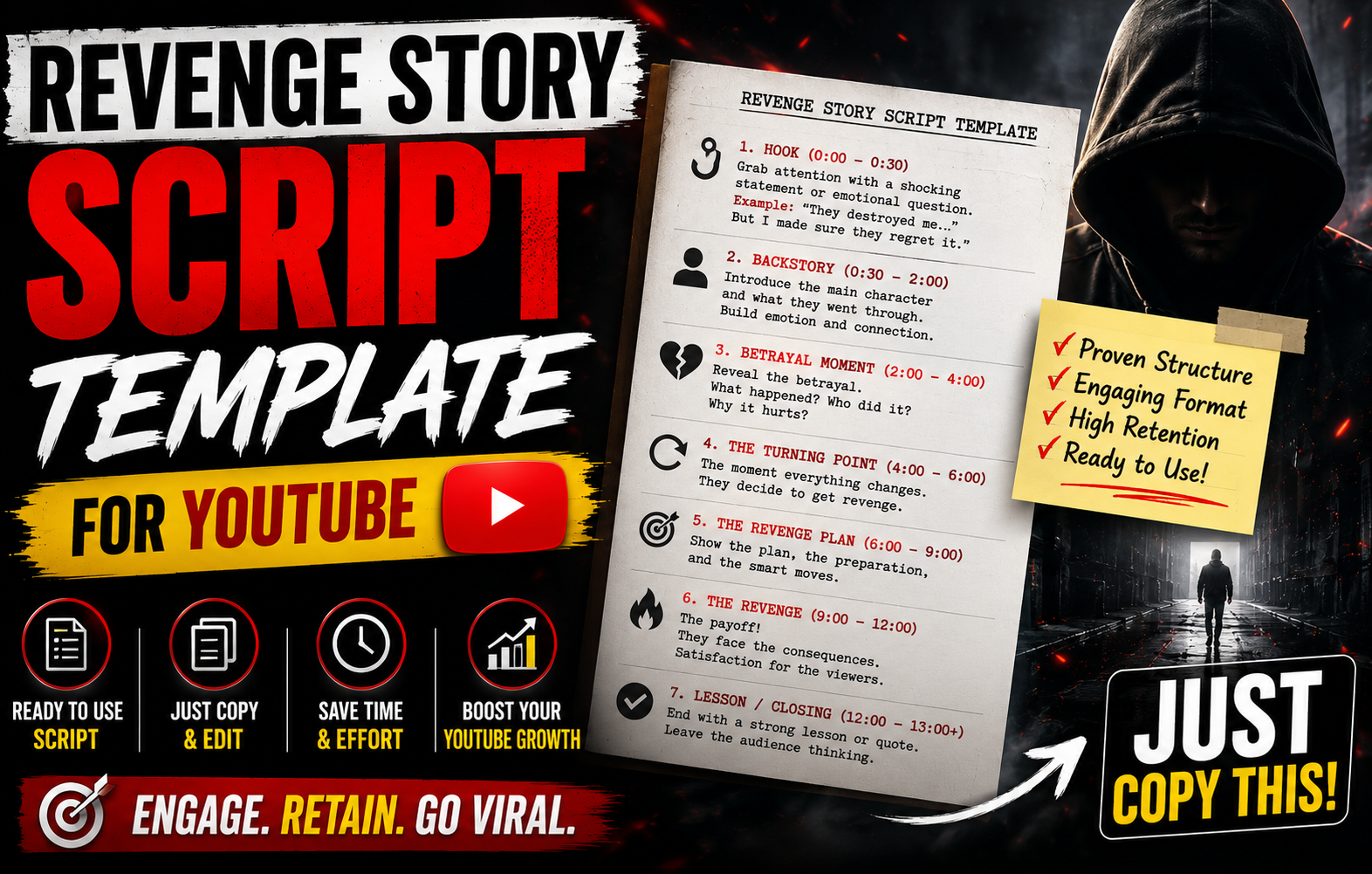
Revenge Story Script Template you can copy, fill the placeholders and create your story video using AI tools. This is completely free AI prompt for betrayal and revenge story creation.
Most betrayal and revenge YouTube channels die in their first 30 days not because the stories are bad, but because the scripts are structured wrong.
They open with background. They introduce the narrator before the injustice. They pace the betrayal too slowly, rush the revenge, and close with a vague ending that gives viewers no emotional release. The result: 35–40% audience retention, zero recommended traffic, and a channel the algorithm refuses to push.
The channels generating $12.82 RPM in this niche the highest verified creator take home rate on YouTube right now are not running on better stories. They are running on a better script structure. A specific, tested, emotionally engineered formula that tells the viewer’s brain exactly what emotional reward is coming and when.
This is that formula. A complete revenge story script template for YouTube that you can copy, fill in, and publish built specifically for the betrayal and revenge narrative niche, with real word for word examples, retention benchmarks for each section, and a full fill in the blank template at the end.
If you are beginner in betrayal and revenge niche explore our dedicated guide for How to Start a Betrayal and Revenge YouTube Channel in 2026
Why Structure Matters More Than Story Quality
YouTube’s algorithm in 2026 primarily rewards watch time and retention rate. A 10 minute video where people watch 8 minutes (80% retention) beats a 20 minute video where people watch 6 minutes (30% retention). Every sentence in your script should serve one purpose: keep viewers watching.
In the betrayal and revenge niche, this principle is amplified. Your audience is watching because they want a specific emotional experience outrage at the injustice, tension during the build, catharsis in the resolution. Deliver that experience in the right order at the right pace and your retention holds. Deliver it out of order or skip emotional beats and viewers drop off, regardless of how dramatic the story is.
This is why identical story premises perform completely differently on different channels. A cheating partner story told with a weak structure averages 38% retention. The same emotional premise told with the 5-act structure below averages 72–78% retention. The story is the same. The structure is different.
For videos between 5 and 15 minutes, a healthy average percentage viewed is 40 to 55 per cent. This is the length where pacing becomes critical. Betrayal and revenge videos that consistently hit 70%+ are outliers and they achieve that because their script structure matches the psychological pattern the audience’s brain is primed for.
That pattern has five acts. Every one of them has a specific job.
The 5-Act Revenge Script Formula Explained
The 5-act revenge formula is derived from the storytelling architecture behind the highest retention betrayal channels in 2026, cross-referenced with the key building blocks of revenge stories including the climax that deals with two possible outcomes: the protagonist’s moment of triumph where they complete their goal and get justice, or their failure that resolves the main conflict.
Here is the high level structure before we break each act apart:
| Act | Name | Timestamp Range | Retention Goal | Primary Job |
|---|---|---|---|---|
| Act 1 | The Injustice Hook | 0:00–1:30 | Hold 80%+ viewers past 90 sec | Open in the injustice. Create outrage AND anticipation. |
| Act 2 | The Build | 1:30–6:00 | Hold 70%+ through background | Layer the betrayal details. Build emotional investment. |
| Act 3 | The Revelation | 6:00–10:00 | Hold 75%+ at the pivot | Full exposure of the betrayal. Shift from victim to planner. |
| Act 4 | The Revenge Execution | 10:00–20:00 | Hold 65%+ through longest section | Methodical, specific, satisfying revenge delivery. |
| Act 5 | The Resolution | 20:00–End | Hold 80%+ for the final 60 sec | Deliver the catharsis. Convert the viewer to a subscriber. |
The two critical retention points to watch in YouTube Studio:
The 90 second mark and the 10-minute mark. If your retention curve shows a significant drop at either point, Act 1 or Act 3 is not doing its job. Most channels struggling with retention have a weak Act 3 the revelation comes too slowly or without sufficient emotional weight, and viewers who have been patient through the build decide the payoff is not coming and leave.
Act 1 — The Injustice Hook: The 15 Second Survival Window
The primary goal of a powerful YouTube hook is to earn the viewer’s investment for the next 30 seconds, thereby maximizing the video’s overall viewer retention rate. The hook must instantly communicate the outcome, benefit, or central conflict of the video, ensuring the viewer understands why they should spend their valuable time watching.
In betrayal and revenge content, this means one thing: open in the middle of the injustice, not before it.
The most common Act 1 mistake is chronological opening starting at “let me tell you about my marriage” before reaching the betrayal. Every second you spend on background before the injustice is a second you are bleeding viewers. 20–40% of viewers drop off in the first 10 seconds. They clicked your video based on title and thumbnail, but if the opening doesn’t immediately confirm they’ll get what they came for, they’re gone.
The 3-component hook formula for betrayal content
Component 1 — The injustice statement (1–2 sentences): State the betrayal directly. Specific, concrete, immediate.
✅ Correct: “My husband of eleven years had a completely separate family. I found out on the morning of our anniversary when a seven-year-old girl called him ‘Daddy’ in a grocery store parking lot.”
❌ Wrong: “Today I want to tell you about something that happened to me a few years ago in my marriage. It was a really difficult time.”
The difference: the correct version drops the viewer directly into a specific, visual moment of betrayal. The wrong version tells the viewer nothing emotional and gives them a reason to leave.
Component 2 — The stakes establishment (1 sentence): Tell the viewer what was at risk or what was lost.
“I had given up my career, my friendships, and eleven years of my life to someone who was living a lie the entire time.”
Component 3 — The control signal (1–2 sentences): This is the most important component. It signals to the viewer that the narrator has power that this is not a victimhood story but a justice story. This single signal is what separates content that gets 35% retention from content that gets 75%.
“I didn’t cry in that parking lot. I drove home, made dinner, and spent the next four weeks building a case. This is what happened to him.”
The control signal tells the viewer: the narrator is not helpless. A satisfying ending is coming. Stay and watch it.
Act 1 hook formulas — copy and adapt
Formula 1 — The Discovery Opener: “[Describe the exact moment of discovery in one sentence]. I had [time period] to process it. Then I started planning.”
Formula 2 — The Timeline Reveal: “For [time period], I smiled, cooked dinner, and acted like everything was fine. What [name/relationship] didn’t know was that I had known the truth for [time period] and I had been using every single day.”
Formula 3 — The Outcome First: “By the end of this story, [antagonist] had lost [specific losses]. I want to tell you exactly how that happened and why I don’t feel guilty about any of it.”
Formula 4 — The Witness Line: “I was not supposed to be in that [location] at that time. But I was. And what I saw changed the next [time period] of my life completely.”
Act 2 — The Build: Emotional Investment Architecture
Act 2 is where most script writers lose viewers they should not lose. The background information that makes the betrayal meaningful is necessary but it has to be delivered in a specific way to prevent the retention curve from dropping.
The job of Act 2 is to make the viewer feel what the narrator felt before they knew the truth. This is called emotional retroframing presenting the narrator’s past happiness or trust in a way that the viewer knows is wrong, creating dramatic irony that keeps them watching to see the moment everything falls apart.
The emotional retroframing technique
Instead of stating background facts neutrally, frame them as evidence of the betrayal the viewer already knows is coming.
❌ Neutral background (causes drop-off): “We met in college in 2013. We got married in 2016. We had a good life together and I trusted him completely.”
✅ Emotional retroframing (holds retention): “I still have the photo from our 2018 vacation. We’re both laughing at something I can’t remember what. What I know now is that he was already seeing her by then. That photo was taken during the same month she says she first knew she was pregnant with his child. I look at that photo differently now.”
The retroframing version takes the same information and charges it with meaning the viewer already knows, creating the feeling of painful dramatic irony that betrayal content is specifically engineered to produce.
Act 2 structure — layer by layer
Layer 1: The relationship history (concrete and specific) Establish the length and depth of trust. Use one or two specific details not a general summary. A specific detail (the exact number of years, a specific shared experience, a particular thing they built together) creates emotional investment that “we were close” never does.
Layer 2: The first signs that were ignored These are the moments the narrator dismissed at the time that they now understand. The darkest moment is the emotional core of a storytelling script. Write it first, in as much detail and specificity as you can. What exactly happened? What were the specific stakes? What did you think or feel? The ignored signs work because they make the viewer feel complicit in the betrayal they were watching the clues too and also let them pass.
Layer 3: The escalation evidence Before the full revelation, there should be a moment where the narrator got close to the truth but did not quite reach it. This creates a near-miss that raises tension before Act 3.
Act 3 — The Revelation: The Hinge That Locks Viewers In
Act 3 is the structural hinge of the entire script. It is where the story shifts from a betrayal narrative to a revenge narrative. Done correctly, it creates what screenwriters call the “point of no return” a moment where the viewer’s emotional investment locks in and dropping off becomes psychologically uncomfortable.
There are two stages to Act 3:
Stage A: The Full Discovery
The moment the complete truth is revealed. This should be the most specific, concrete, visually described moment in the entire script. Vague revelations (“I found out everything”) generate no emotional response. Specific revelations generate visceral reactions.
“The folder had 47 pages in it. Bank statements. Hotel receipts. Screenshots of messages. A lease agreement for an apartment I had never seen signed jointly. Two names. His and hers. The lease started three months after our wedding.”
Every detail adds weight. The number 47 is more impactful than “many.” The lease starting three months after the wedding is more devastating than “it had been going on a long time.”
Stage B: The Control Decision
This is the single most important moment in your entire script. The moment the narrator decides not to react immediately but to plan. Get this line right and your retention locks in. Get it wrong and your audience starts drifting in Act 4.
High retention control decision lines:
- “I put the folder back exactly where I found it. I drove to work. I did not say a single word.”
- “I closed the laptop, made tea, and sat at the kitchen table for forty minutes deciding what to do. By the time I finished that tea, I had decided three things.”
- “The anger was there. But there was something under it that felt colder and much more useful. I decided to use that instead.”
What all of these have in common: They show the narrator transitioning from emotional reaction to strategic thinking. The viewer registers this shift as power and power is what they came to see.
The Act 3 bridge line
End Act 3 with a single sentence that bridges into Act 4 and re-establishes the promise from your opening hook:
“I had [time period] before [event]. That was enough.”
Act 4 — The Revenge Execution: The Longest and Most Important Act
Act 4 is the act viewers came for. It is also the act most scripts rush, underwrite, or handle incorrectly. The three most common Act 4 mistakes:
Mistake 1: Making the narrator angry instead of strategic Screaming matches, emotional confrontations, and dramatic tearful scenes feel like satisfying revenge but actually reduce audience retention because they position the narrator as reactive rather than in control. The highest retention revenge executions are methodical, calm, and multi-step. Viewers stay for controlled power, not emotional outbursts.
Mistake 2: Rushing the execution Act 4 should be the longest act in your script. Viewers who invested through Acts 1–3 have earned the detailed execution. Give them every step. What was prepared. What was communicated to whom. What happened when. In what order. The satisfaction comes from the methodical, layered delivery not from a single confrontation.
Mistake 3: Making the revenge disproportionate Revenge that far exceeds the original betrayal makes the narrator unsympathetic. The viewer’s satisfaction depends on justice feeling proportional. Losing a job for cheating: proportional. Losing their entire life, relationships, housing, and career over a workplace slight: disproportionate and unsatisfying.
The Act 4 structure — step by step
Step 1: The preparation phase
Detail what the narrator did before any confrontation. This is the planning section and it is crucial for the strategic positioning of the narrator.
“Week one: I contacted a [relevant professional lawyer, financial advisor, HR]. Week two: I moved [asset/resource] that they didn’t know about. Week three: I made contact with [third party who needed to know].”
Step 2: The evidence collection (if applicable)
The most satisfying revenge scripts include a moment where the narrator assembled undeniable evidence before confrontation. This is both a plot element and a retention device each piece of evidence revealed is a mini payoff that holds viewers through the longer Act 4.
Step 3: The strategic communication sequence
Who found out, and in what order? The most dramatically effective revenge scripts tell third parties before telling the antagonist. The viewer knows something the antagonist does not another layer of dramatic irony that holds attention.
Step 4: The confrontation (if included)
Not all revenge scripts include a direct confrontation and those that do should position it as the narrator’s controlled choice rather than an emotional reaction. If included, the confrontation should be brief, controlled, and devastating in its calmness.
Strong confrontation script line: “I had one sentence prepared. I had rehearsed it twice. I sat across from [name], waited for silence, and said it. Then I left without waiting for a response.”
Step 5: The cascade of consequences
The most satisfying Act 4s end with multiple consequences arriving for the antagonist professional, social, financial, relational each one landing separately and escalating. This escalation structure is what drives the retention spike that high performing revenge channels consistently show in YouTube Studio at the 15–18 minute mark.
Act 5 — The Resolution: The Emotional Payoff That Builds Subscribers
Act 5 has three jobs, and all three must be present for the closing to convert viewers into subscribers.
Job 1: The karma confirmation
State clearly and specifically what the antagonist’s situation is now. This is what the viewer has been watching to see. Deliver it directly, without hedging.
✅ “As of [timeframe], he no longer works in [industry]. The second family he chose over ours has been through two rounds of counseling. He sent me a message six months ago. I did not open it.”
❌ “Things eventually worked out and he got what he deserved.”
Job 2: The narrator’s current state
Brief one to two sentences. Where is the narrator now? This provides the audience with the validation that leaving was right, moving forward was right, and the revenge was the end of a chapter rather than a permanent obsession.
“I moved to [city/state] eighteen months ago. I took the position I had turned down when we got married. I go to sleep without checking my phone. That took longer to earn than anything else in this story.”
Job 3: The subscriber conversion line
The final 15–30 seconds of your script should be written specifically to convert the emotional connection of the resolution into a subscribe action. The most effective subscribe conversion lines for this niche connect the viewer’s personal experience to the channel’s ongoing content.
High conversion closing formulas:
Formula 1 — The shared experience close: “If any part of this felt familiar if you have been sitting across from someone and smiling while carrying something they don’t know you know I want you to hit subscribe. I share a new story every [day/week]. Some of them are even longer than this one.”
Formula 2 — The justice community close: “I read every comment. I know a lot of you have been through something similar. Tell me in the comments what you would have done differently. And subscribe because the next story is going to make this one look mild.”
Formula 3 — The curiosity close: “I have not told you everything. There is one more part of this story I left out deliberately. I am going to share it in a follow up video for subscribers only. Subscribe with the bell notification on. It will be up [day].”
Pattern Interrupt Techniques for Betrayal Scripts
Human attention spans on video are measured in seconds, not minutes. You need to recapture attention constantly.
Pattern interrupts are scripted moments that reset viewer attention before they drift. In voiceover narrated betrayal content, pattern interrupts cannot rely on visual cuts (since you are using stock footage or AI visuals) they have to be scripted into the narration itself.
Verbal pattern interrupt techniques for betrayal scripts
Technique 1: The pause question A direct rhetorical question dropped into the narration mid act. “I need to stop here for a second. Because what I found next changes everything I just told you.” This works by creating a micro-curiosity gap that refreshes viewer engagement at the exact moment attention is starting to drift.
Technique 2: The number revelation Introducing a specific number that the viewer did not expect. “I counted later. He had sent her 1,847 messages in the six months I thought we were fine. I know the exact number because I printed all of them.” Specific numbers create visceral impact and snap attention back.
Technique 3: The time jump “Fast forward six weeks. Everything I had set up was in motion. Three things happened in the same 24-hour period that I did not plan but I was ready for.” Time jumps signal that something is about to happen and buy 2–3 minutes of renewed attention.
Technique 4: The quiet line A sudden shift to very short, very simple sentences after a longer paragraph. “She knew. She had always known. And she kept coming to our house anyway.” The rhythm shift creates the sensation of a revelation landing even when it is a piece of information already introduced.
Technique 5: The object detail Ground the abstract in a specific physical object. “He had left his laptop open on the kitchen table. I have thought about that detail many times since. Of all the mornings to leave it open. Of all the windows to leave active.”
9. Word Count and Timing Guide Per Act
Most creators speak at 130–150 words per minute in narration. Use this table to hit the target timestamp for each act:
| Act | Target Duration | Word Count (130 wpm) | Word Count (150 wpm) | Retention Target |
|---|---|---|---|---|
| Act 1 — Hook | 1 min 30 sec | ~195 words | ~225 words | 80%+ |
| Act 2 — Build | 4 min 30 sec | ~585 words | ~675 words | 70%+ |
| Act 3 — Revelation | 4 min | ~520 words | ~600 words | 75%+ |
| Act 4 — Execution | 10 min | ~1,300 words | ~1,500 words | 65%+ |
| Act 5 — Resolution | 2 min | ~260 words | ~300 words | 80%+ |
| Total | ~22 min | ~2,860 words | ~3,300 words | — |
A 22 minute video at these word counts gives you 4–6 mid roll ad slots, which is where the $12.82 RPM comes from. Videos under 12 minutes in this niche miss the mid-roll revenue window and earn 40–60% less per 1,000 views. Do not cut your script short to keep production time down.
The Complete Fill In The Blank Revenge Story Script Template To Copy
Copy this entire template. Replace everything in [brackets] with your story’s specific details. Do not change the structural transitions between acts they are the retention mechanics.
ACT 1 — THE INJUSTICE HOOK
[OPEN DIRECTLY IN THE MOMENT OF BETRAYAL – no introduction, no background]
“[Describe the exact moment of discovery in one specific, visual sentence. Include a concrete detail a name, a location, a number, a physical object.]
[State what was at risk or what was lost as a result of this betrayal – one sentence.]
[THE CONTROL SIGNAL – The narrator decides not to react immediately. Two sentences maximum. This line must show calm decision making, not emotion.]
This is what happened next.”
ACT 2 — THE BUILD
“[His/Her/Their] name is [name or pseudonym]. We had been [relationship type] for [exact time period].
[ONE specific detail that establishes the depth of trust – a shared experience, a sacrifice made, a specific moment of genuine connection.]
[TWO OR THREE IGNORED SIGNS – Present each as something the narrator dismissed at the time and now understands differently. Frame each using retroactive knowledge: ‘What I know now is…’ or ‘I understand now why…’]
[THE NEAR-MISS – A moment where the narrator almost found out the truth but didn’t. This raises tension before Act 3.]
I thought I knew exactly what my life was. I was [time period] wrong.”
ACT 3 — THE REVELATION
“[THE SPECIFIC DISCOVERY – Describe the physical moment of finding out the full truth. Use concrete details: documents, messages, dates, numbers, locations. The more specific, the more emotionally impactful.]
[LAYER THE DETAILS – Add two to three additional pieces of evidence that expand the scope of the betrayal beyond the initial discovery.]
[THE EMOTIONAL RESPONSE Two to three sentences on the internal reaction. Keep it controlled and specific. Avoid generic phrases like ‘I was devastated.’]
[THE CONTROL DECISION – The narrator decides to plan rather than react immediately. This is the hinge of the entire script. One to two sentences. Calm. Decisive. Cold.]
I had [time period] before [triggering event the confrontation, the meeting, the filing, the announcement]. That was more than enough.”
ACT 4 — THE REVENGE EXECUTION
“[PREPARATION – What did the narrator do before any confrontation? List specific preparatory actions in sequence. Use time markers: ‘First,’ ‘By [day/week],’ ‘Before [event]’]
[EVIDENCE COLLECTION – What was assembled and how? Be specific about what was documented, copied, saved, or shared.]
[STRATEGIC COMMUNICATION – Who found out before the antagonist did? In what order? Why that order?]
[PATTERN INTERRUPT #1 – Use one of the verbal techniques: pause question, number revelation, time jump, quiet line, or object detail. Place here at approximately the 13–14 minute mark.]
[THE CONFRONTATION if included – Brief, controlled, the narrator’s choice. One prepared line delivered calmly.]
[THE CASCADE – List the consequences that followed in sequence. Each consequence should be specific and proportional to the betrayal.]
[PATTERN INTERRUPT #2 – Place at approximately the 17–18 minute mark. A second refresh of attention before the final act.]
[Name/antagonist] had options throughout all of this. [He/She/They] made a choice at every stage. So did I.”
ACT 5 — THE RESOLUTION
“[THE KARMA CONFIRMATION – State specifically and concretely what the antagonist’s situation is now. Two to three sentences. No hedging.]
[THE NARRATOR’S CURRENT STATE – Brief, one to two sentences. Where are you now? What does normal life feel like?]
[THE UNIVERSAL STATEMENT – One sentence that speaks to anyone who has been betrayed. This line is what viewers share and screenshot.]
[THE SUBSCRIBE CONVERSION – Use one of the three formulas: shared experience close, justice community close, or curiosity close. 20–30 seconds maximum.]”
End of template.
How to Use AI to Generate Revenge story
AI script tools have become genuinely useful in 2026, especially for generating first drafts and hook variants. The key limitation across all tools is niche-specific accuracy: AI doesn’t know your audience’s specific language, your competitors’ top videos, or the data patterns in your space. The best workflow combines AI generation with human editing.
Here are the exact AI prompts for use with Claude, ChatGPT, or Gemini that generate structurally correct betrayal/revenge scripts using the 5-act formula:
AI Prompt For Betrayal Revenge Story Generation
Prompt 1 – Full script generation
You are a YouTube scriptwriter specialising in betrayal and revenge
narrative content. Write a complete 2,800-word script using the
5-act structure below. Open directly in the injustice — no
introductory framing. Use specific concrete details throughout.
The narrator must demonstrate controlled strategic thinking in
Act 3 and Act 4, not emotional reactions.

Story premise: [Paste your story premise here]

Act structure:
Act 1 (195 words): Open directly in the betrayal moment. Hook,
stakes, control signal.
Act 2 (585 words): Background through emotional retroframing.
Three ignored signs. One near-miss.
Act 3 (520 words): Full revelation with specific details.
Control decision pivot line.
Act 4 (1,300 words): Preparation, evidence, strategic
communication, confrontation if any, cascade of consequences.
Include two pattern interrupts.
Act 5 (260 words): Karma confirmation, narrator's current state,
universal statement, subscriber conversion close.
Prompt 2 — Hook only (when you want multiple options)
Write 5 different opening hooks for a YouTube betrayal and revenge
story about [story premise]. Each hook must:
1. Open directly in the injustice, not before it
2. Use a specific concrete detail in the first sentence
3. Include a control signal — the narrator deciding to plan
   rather than react
4. Be 150–200 words maximum
5. End with a bridge line that creates anticipation for what follows
Prompt 3 — Pattern interrupts
For this section of a YouTube betrayal script [paste Act 4 draft],
add three verbal pattern interrupts that refresh viewer attention
without breaking the narrative flow. Use these techniques: one
pause question, one number revelation or specific detail, and one
quiet line (short simple sentences after longer paragraphs).
Insert them at natural pacing transition points.
Critical reminder: All AI generated scripts require human editing before publishing. Review each draft for generic phrasing, replace vague statements with specific details, and ensure the narrative voice is consistent throughout. YouTube’s inauthentic content policy requires demonstrable original creative contribution AI first drafts that are published unedited are at risk of demonetization.
Always enable the “Altered or synthetic content” toggle in YouTube Studio before publishing any video narrated with AI voiceover. Check your channel’s current monetization status and estimated earnings anytime with Toolbil’s free YouTube Monetization Checker.
Script Mistakes That Destroy Retention
These are the six most common scripting mistakes in betrayal and revenge channels and the fix for each.
Mistake 1: Chronological opening
What it looks like: Starting the script at the beginning of the relationship or situation, building toward the betrayal.
Why it kills retention: 20–40% of viewers drop off in the first 10 seconds. If your hook is “let me tell you about how we met,” those viewers are gone before the betrayal even arrives.
The fix: Move the moment of discovery to the first sentence. Every relevant background can be delivered in Act 2 as retroframed context.
Mistake 2: Telling emotions instead of showing specifics
What it looks like: “I was devastated.” “It was the worst day of my life.” “I couldn’t believe what I was seeing.”
Why it kills retention: Generic emotional statements create no visceral response in the viewer. Specific details do.
The fix: Replace every generic emotion statement with a concrete sensory detail. Not “I was devastated” but “I sat in my car in the parking lot for forty minutes before I could drive. I know it was forty minutes because I checked the clock three times.”
Mistake 3: Making the narrator emotional and reactive in Act 4
What it looks like: The revenge is a screaming confrontation, a dramatic public scene, or an emotional breakdown.
Why it kills retention: Viewers watch betrayal content for the satisfaction of controlled justice, not emotional drama. A narrator who loses control in Act 4 makes the viewer feel uncomfortable rather than satisfied.
The fix: Keep the narrator strategic and calm through Act 4. Emotion belongs in Acts 1 and 3. Acts 4 and 5 belong to controlled, methodical execution.
Mistake 4: A vague resolution
What it looks like: “Everything eventually worked out.” “She got what she deserved.” “Things are better now.”
Why it kills retention: The resolution is the emotional payoff the viewer sat through 20 minutes to receive. A vague payoff feels like a broken promise.
The fix: Be specific. State exactly what the antagonist’s situation is now professional, social, relational, financial. One specific consequence is more satisfying than three vague ones.
Mistake 5: No control signal in Act 3
What it looks like: The narrator finds out the full truth and immediately confronts the antagonist.
Why it kills retention: The control signal is the moment viewers understand this is a justice story, not a victimhood story. Without it, Act 4 loses its narrative momentum.
The fix: Insert the decision moment. Even one sentence: “I did not say a word. I needed time to think.” This pause creates the structural shift that holds Act 4 retention.
Mistake 6: Copying Reddit posts verbatim
What it looks like: Pasting a Reddit story directly into an AI voiceover tool and publishing it.
Why it kills the channel: YouTube’s inauthentic content policy, updated July 2025, explicitly includes content that narrates external sources without adding original creative contribution. Channels building on verbatim Reddit narration are being demonetized in 2026 with increasing frequency.
The fix: Use Reddit stories as source material only. Rewrite completely in your own narrative voice, add structural elements the original post lacks, and ensure the published script could not have been produced without your specific creative choices. Use Toolbil’s YouTube Video Data Extractor to analyse the tags, structure, and metadata of top-performing channels in this niche and understand what original elements their scripts contain.
Frequently Asked Question
What is the best revenge story script template for YouTube? The most effective template for betrayal and revenge YouTube channels is the 5-act structure: Injustice Hook, The Build, The Revelation, The Revenge Execution, and The Resolution. The complete fill-in-the-blank version of this template is in Section 10 above. It is specifically designed for 20–25 minute videos that earn multiple mid-roll ad placements and the $12.82 RPM this niche produces.
How long should a revenge story script be for YouTube? Target 2,800–3,300 words for a 20–22 minute video at 130–150 words per minute narration speed. This length enables 4–6 mid-roll ad placements, which drives the premium RPM this niche earns. Scripts under 1,500 words (under 12 minutes) miss the mid-roll revenue window and earn significantly less per 1,000 views.
What is the most important part of a revenge story script? The control signal at the end of Act 3 — the moment the narrator decides to plan rather than react immediately. This single structural element is what separates betrayal content with 35% retention from content with 70%+ retention. Without it, Act 4 loses narrative momentum and viewers drift.
Can I use AI to write my betrayal and revenge YouTube script? Yes, with mandatory human editing. AI tools generate structurally competent first drafts quickly, but they default to generic emotional statements instead of specific concrete details the exact element that drives retention. Use the prompts in Section 11 to generate a first draft, then edit every generic phrase into a specific detail. All AI-narrated content must have the YouTube “Altered or synthetic content” disclosure enabled before publishing.
How do I avoid demonetization on a betrayal and revenge channel? Three rules: (1) Never narrate Reddit posts or any external source verbatim rewrite completely in your own voice. (2) Enable the “Altered or synthetic content” toggle for all AI-narrated videos. (3) Ensure every published script demonstrates original creative contribution through specific details, narrative voice, and structural choices that could not have been auto generated without human input.
What makes betrayal and revenge content hold 70%+ audience retention? The combination of dramatic irony (the viewer knowing the truth before the antagonist does), the control signal (making the narrator strategically powerful rather than a victim), specific concrete details (which create visceral emotional response), and proportional justice (which delivers the satisfaction the viewer came for). Scripts that hit all four elements consistently outperform scripts that hit only one or two.
Where do I find stories for my betrayal and revenge YouTube channel? Three sources: (1) Reddit — r/AITA, r/ProRevenge, r/relationship_advice, r/MaliciousCompliance — as source material to be completely rewritten. (2) Viewer submissions via a Google Form in your channel description. (3) Original fiction, which has zero copyright concerns and unlimited supply via AI-assisted generation. Check Toolbil’s free YouTube Tag Generator to find the exact search terms your target audience uses when looking for this type of content.
The Script Is the Product
In the betrayal and revenge niche, the algorithm does not care about your equipment, your thumbnail quality, or how many videos you post per week if your scripts cannot hold viewers. Retention is everything and retention in this niche is completely structural.
The 5-act formula above produces 70%+ audience retention when followed correctly. The fill in the blank template in Section 10 is the exact starting point. Every section of that template has a specific retention job. Do not skip sections, do not reorder acts, and do not rush Act 4.
If you want to see what the top-performing channels in this niche are earning from their scripts, use Toolbil’s free YouTube Monetization Checker to check any channel’s estimated monthly revenue instantly, free, no login needed.

Jordan Blake
Hey ,I'm Jordan Blake a Dallas based YouTuber and digital marketing strategist with 8 years of experience growing YouTube channels across finance, tech, and SaaS niches. I negotiated brand deals with companies including NordVPN, Squarespace, and Shopify, and currently manages monetization strategy for a portfolio of mid tier US YouTube channels.